Ctrl+K

optmat

  • Introduction
  • User guide
  • The data
  • Developers guide
  • API
  • GitHub
  • Introduction
  • User guide
  • The data
  • Developers guide
  • API
  • GitHub

Section Navigation

  • Source catalogue
    • Alphabetical source index
  • The curated data
  • Quantity vocabulary
  • The review register
  • Gallery
    • The curated data
      • Wavelength coverage of the curated data
      • Cross-checks: phase-matching ratios and group-delay dispersion
      • Argon: the curated data
      • Methane: the curated data
      • Carbon dioxide: the curated data
      • Deuterium: the curated data
      • Hydrogen: the curated data
      • Helium: the curated data
      • Krypton: the curated data
      • Nitrogen: the curated data
      • Nitrous oxide: the curated data
      • Neon: the curated data
      • Oxygen: the curated data
      • Sulphur hexafluoride: the curated data
      • Xenon: the curated data
    • The dispersion models
      • CO2 from the ultraviolet to its infrared windows
      • The compact models against their parents
      • Helium in the extreme ultraviolet
      • Neon, argon, krypton and xenon in the extreme ultraviolet
      • Argon: the fitted model
      • Methane: the fitted model
      • Carbon monoxide: the fitted model
      • Carbon dioxide: the fitted model
      • Deuterium: the fitted model
      • Hydrogen: the fitted model
      • Helium: the fitted model
      • Krypton: the fitted model
      • Nitrogen: the fitted model
      • Nitrous oxide: the fitted model
      • Neon: the fitted model
      • Oxygen: the fitted model
      • Ozone: the fitted model
      • Sulphur hexafluoride: the fitted model
      • Xenon: the fitted model
    • Accuracy and comparisons
      • Capillary zero-dispersion wavelength
      • Linear density scaling against Lorentz-Lorenz
      • Dispersion uncertainty and sensitivity to dataset selection
      • Group-velocity dispersion: the fits against the formulas in use
      • The dispersion of a helium-argon fill against pressure
      • Robustness: leaving one dataset out
    • The third-order and Raman response
      • The second hyperpolarizability: every process on one curve
      • Third-order uncertainty: statistical and working estimates
      • Raman: the response functions of the gases
    • Ionisation
      • Ionisation: the Coulomb factor against Schrödinger calculations
      • Ionisation: the measured yields of argon, krypton and xenon
      • Ionisation: the rates of the noble gases
      • Ionisation: the noble gases against all-electron rates at 390 nm
      • Ionisation: the static rates of helium, neon and argon
      • Ionisation: the rates of molecules
      • Ionisation: optmat’s rate of molecules
      • Ionisation: the measured yields of N2 and O2
      • Two-photon ionisation of the noble gases
    • Solids
      • Raman: fused silica’s response
      • Fused silica: the complex index and n2
  • The data
  • Gallery
  • Solids

Solids#

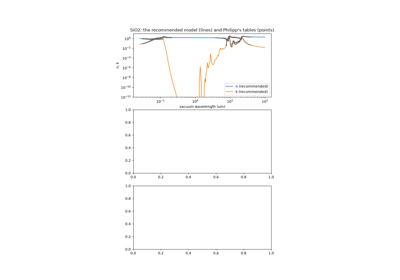
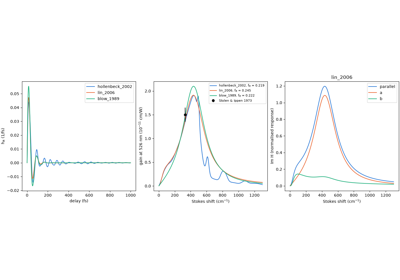
Fused silica: its complex index, its n2 and its Raman response.

Raman: fused silica’s response

Raman: fused silica's response

Fused silica: the complex index and n2

Fused silica: the complex index and n2
previous

Two-photon ionisation of the noble gases

next

Raman: fused silica’s response

Show Source

© Copyright 2026, John C. Travers and contributors.

Created using Sphinx 9.1.0.

Built with the PyData Sphinx Theme 0.21.0.